When a recycling facility starts looking for a horizontal baler, capacity is usually one of the first numbers discussed. A supplier may recommend 3 tons per hour, 8 tons per hour or even 15 tons per hour. The larger machine can look safer on paper, but paying for capacity that the facility rarely uses can be just as costly as buying a baler that cannot keep up.
The better starting point is your actual waste flow: what material arrives, how much arrives during the busiest hours, and how quickly it needs to leave the processing area.
Daily Volume Is Only Half of the Capacity Question
Suppose a facility processes 20 tons of cardboard per day. That number alone does not tell a horizontal baler manufacturer enough to select the machine. Twenty tons spread evenly across two shifts is very different from 20 tons arriving mainly during four peak production hours.
Material matters too. Loose cardboard, shredded paper, PET bottles and plastic film occupy different volumes before compression and behave differently in the chamber. This is why throughput should be considered together with feed opening, bale density and cycle time rather than treated as a single catalogue number.
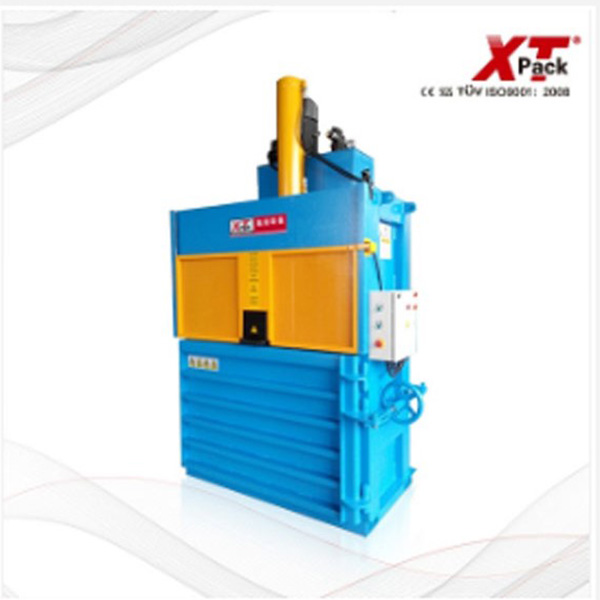
For reference, XTPACK's medium-sized full automatic balers are designed for cardboard, paper and plastic applications, while large-sized full automatic balers cover substantially higher-volume operations. Depending on configuration, the large series lists throughput from around 5 tons/h into the 20+ tons/h range.
The Expensive Problem Is Often Upstream of the Baler
A baler capable of 10 tons per hour does little good if material reaches it too slowly. In many plants, the real bottleneck is collection and feeding rather than compression.
This becomes particularly important in corrugated plants, printing operations and recycling centers where scraps are generated continuously. Connecting the baler with a belt conveyor can create a steadier material flow and reduce repeated forklift or manual handling.
The same thinking applies when comparing automatic and semi-automatic equipment. A semi-automatic horizontal baler can make commercial sense where volumes are moderate and manual tying is acceptable. When material arrives continuously and labor becomes the constraint, automatic feeding and tying start to justify the higher investment.
In other words, don't pay for automation simply because it is available. Pay for it when it removes a real operating cost.
Look at the Bale Leaving the Machine, Not Just the Machine Going In
One specification is often overlooked during quotation comparisons: the finished bale.
Denser, consistently sized bales can influence warehouse space, loading frequency and transport efficiency. XTPACK's 100-ton automatic models, for example, list OCC bale densities around 400–500 kg/m³, while some larger 150–200-ton configurations list 550–600 kg/m³. The right density is not automatically the highest one; it should fit the material and the way the bales will be stored, loaded and sold.
This is also why two quotations for a horizontal baler for sale can differ considerably even when both suppliers describe their equipment as “automatic horizontal balers.” Press force, chamber dimensions, feeding opening, motor configuration, tying system and expected output may be completely different.
As another industry reference, Bramidan notes that baler capacity depends not only on machine size but also on press force and waste type. That is a useful point when comparing supplier specifications: one headline capacity figure rarely tells the whole story.
A Better Quotation Starts With Five Numbers
Instead of sending several horizontal baler manufacturers a message asking, “How much is your 100-ton baler?”, send them information they can actually work with: material type, tons generated per day, peak hourly volume, required bale size or weight, and available installation space.
Those details quickly show whether a smaller semi-automatic machine is enough, whether a medium automatic baler offers better value, or whether the operation genuinely needs a high-throughput line. They also make quotations from different manufacturers much easier to compare on the same basis.
XTPACK offers a range of horizontal balers for different materials and processing volumes. If you are planning a new recycling line or replacing a baler that no longer keeps up with production, send us your material and current daily output. We can help match the capacity, feeding method and automation level to your actual operation.
Talk to XTPACK about your baling requirements →